Peeli Batti Project:
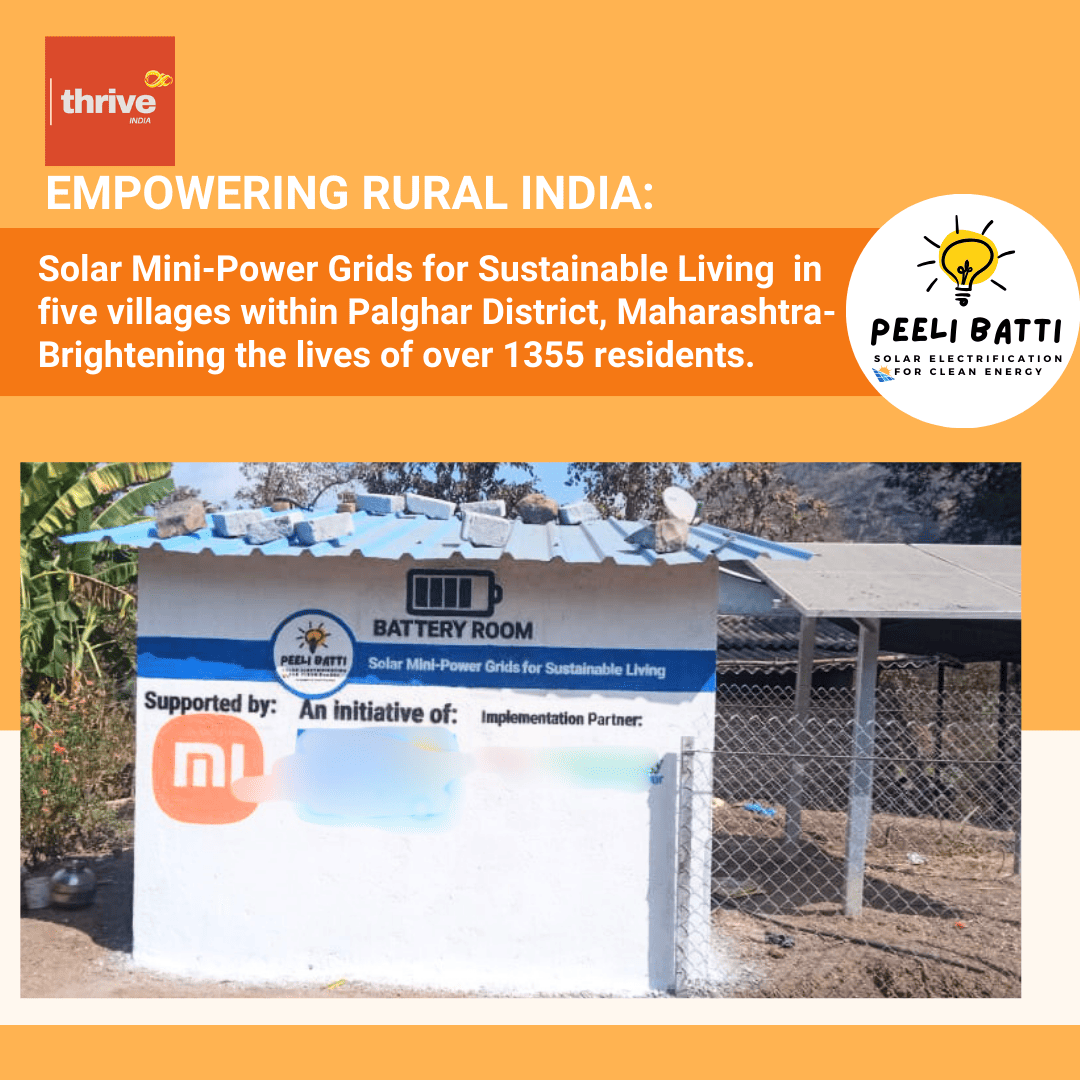
Thrive India’s mission to connect rural/peri-urban belts of India to solar mini-power grids and help them in better livelihood opportunities, continued education, becoming self sustainable, & preventing migration by comfortably using 100% clean electricity.
Overview
India is in the early stages of a green energy boom led by the private sector, in terms of operations and its life cycle. Solar energy is sustainable, renewable and available in abundance. The cost of using solar power to produce electricity goes down every year.The Global Carbon Budget 2022 report states that if the emissions stay at the levels they are in 2022, it will take just 9 additional years for atmospheric CO2 to reach catastrophic levels leading to 1.5°C global warming. Emerging economies such as India account for 67% of carbon-dioxide emissions from energy in the past year.
There is a huge potential of switching to solar based electricity for community based organizations and nonprofits. Renewable Capacity Statistics 2023, by the International Renewable Energy Agency (IRENA) shows that 83% of all power capacity added last year was produced by renewables. There is an untapped potential to shift to a cleaner approach. However due to capital cost, many are at a disadvantage especially remote locations in rural India. Conventional electricity is a far-fetched dream in many villages in India even today. Due agricultural focus, ongoing needs of the community, and adoption to solar based electricity will help mitigate access to electricity and its potential emissions thereby providing a two pronged approach to improving lives by creating sustainable source of electricity and creating a ripple effect by improving health, education and livelihood opportunities. >Treating sewage before it enters a waterbody has thus become a necessity – if we want a clean and healthy environment. While a permanent solution to this would be to curb pollution at the source, there are intermediary measures that can be taken to restore a waterbody to its wholesome original self, conserve and enhance its biological diversity, preserve its ecosystem, and manage it while meeting current and future demand – without compromising on its ecological health and character. The growing scale and urgency of the problem prompted us to enter the waterbody rejuvenation space